4 min read
What is the difference between low risk and guaranteed capital?
Prudent cash management starts with understanding risk ratings, what a guarantee covers and the returns you can expect.
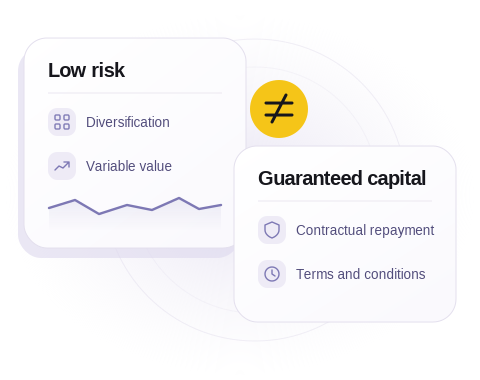
Is "Low Risk" riskier than guaranteed capital?
The word risk does not, on its own, mean a speculative investment. Some funds are designed to seek stability and earn returns on cash through short-term assets with high credit quality.
Guaranteed capital refers to a commitment to repay, subject to conditions. It is important to understand that even ordinary bank deposits have a limit to their deposit guarantee coverage. Above that limit, recovering the money depends on the bank’s ability to pay.
Low risk describes exposure to potential losses. In a diversified fund, that assessment is not limited by a coverage ceiling like the one for deposits. The portfolio can spread investments across several banks, governments or other issuers, rather than depending on a single entity.
Understanding the rating
What does a fund risk rating of 1/7 mean?
For investment funds, the Key Information Document (KID) presents a risk indicator from 1 to 7. Level 1 is the lowest risk category and 7 the highest, taking the recommended holding period into account.
This rating applies to the fund as a product, because it combines several assets, rather than to each share or bond in its portfolio. It is not a scale that automatically applies when buying individual shares or plain bonds directly.
A fund rated 1/7, such as Numo Money Market, sits at the lower-risk end of this scale. The indicator assesses the fund’s market and credit risks. High credit quality helps reduce the risk of issuers failing to repay their debts, while diversification reduces dependence on a single entity.
What contributes to lower risk?
- Asset qualityThe financial strength of issuers, such as governments or banks with high credit quality, helps reduce default risk.
- Short maturitiesIn general, shorter-term debt is less sensitive to interest rate changes than comparable longer-term debt.
- DiversificationSpreading the portfolio across several issuers reduces dependence on a single entity. These factors should be assessed together.
What does the deposit guarantee cover?
For eligible deposits, protection under Portugal’s Deposit Guarantee Fund generally has a limit of €100,000 per depositor, per institution, not per account. For example, if the same company deposits €150,000 with one bank, €50,000 falls outside that general limit.
The bank is obliged to repay the money. However, if it cannot do so, the amount above the guarantee limit may be partly or entirely lost. In liquidation, recovery depends on the assets available and the order in which creditors are paid.
For your business cash, look at the whole picture
A low-risk solution can be an alternative to a bank deposit when a company wants to earn returns on surplus cash and diversify its risk exposure. The decision depends on the assets, costs and withdrawal timeframe, more than on the existence of a deposit guarantee.
Numo provides access to the money market through Numo Money Market, with withdrawals on the next business day. An alternative for exploring this balance between returns, liquidity and low risk.
Make more of your business cash, use Numo.
Discover NumoInvestment funds are not covered by the deposit guarantee and can lose capital. Liquidity and returns depend on the product’s terms. This article is for information only and does not constitute financial advice.